
How to Choose the Right Preschool for Your Child in India (2026): A Parent's Checklist
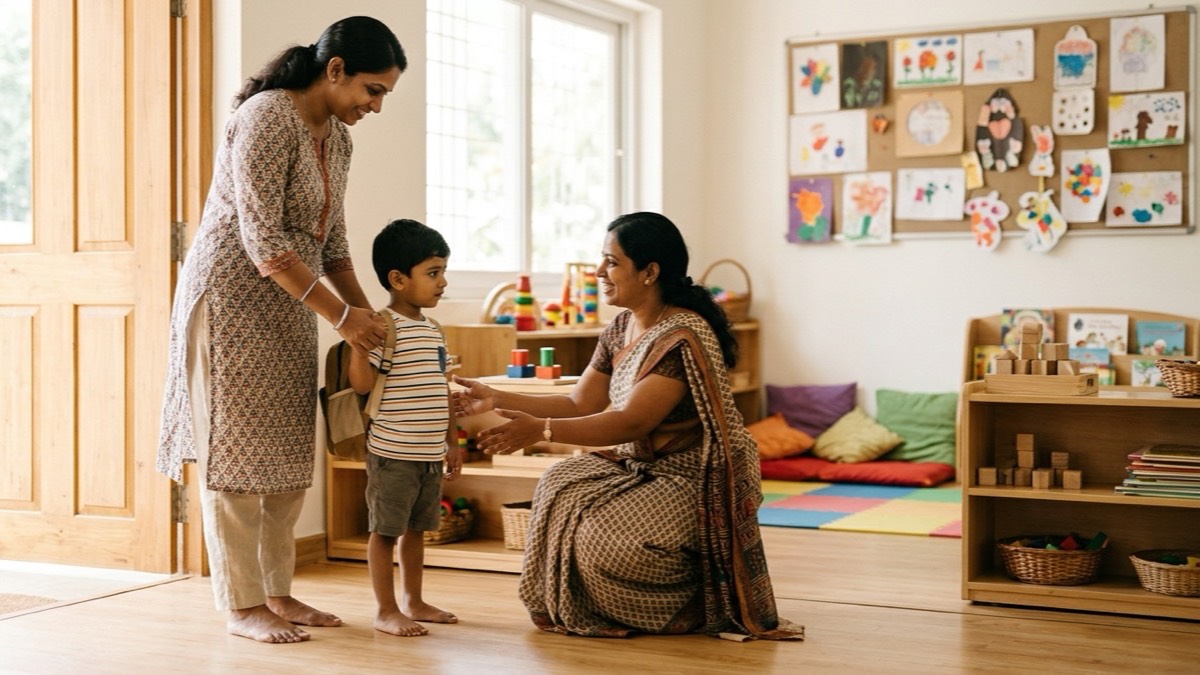
Admission season is here. Between November and March, most families in India visit three or four preschools, and most come home with a vague feeling about each one.
A feeling matters. But you can do better than "it seemed nice". This guide tells you what to check, in order of importance, what Indian guidelines say a good preschool should do, and which answers should make you walk away. There is a printable checklist in the middle to take on your visits.
What matters most when choosing a preschool?
Safety first, then the adults: how many there are, how warmly they speak to children, how qualified they are and how long they stay. After that, a play-based approach suited to your child's age. Facilities, brand name and fees matter, but less than parents often think.
A simple order to judge any preschool by:
- Is my child safe here? Secure entry, verified staff, supervised toilets, a clear pickup process.
- Who will be with my child all morning? Enough adults, kind and patient, who stay year after year.
- How do children spend the day? Mostly play, talk, stories, movement and hands-on activities, not worksheets.
- Does it fit our life? Distance, timings, fees and how the school talks to parents.
Everything below fills in those four questions.
What is the right age to start preschool, and which class?
Most children start playgroup between 2 and 3 years old, but the class that matters is Class 1. The Ministry of Education has asked every state to admit children to Class 1 only at age 6 or above, so work backwards from that date.
In February 2024, the Ministry of Education wrote to all states asking them to set the Class 1 admission age at 6+, in line with NEP 2020. States set their own cut-off dates. Karnataka, for example, requires a child to have completed 6 years by 1 June for Class 1 from 2025-26, with a one-time 60-day relaxation announced for 2026-27.
A typical age chain under the Class-1-at-6 rule:
| Age on 1 June | Usual class |
|---|---|
| 2 to 3 years | Playgroup |
| 3 to 4 years | Nursery |
| 4 to 5 years | LKG |
| 5 to 6 years | UKG |
| 6 years or more | Class 1 |
Exact cut-offs vary by state and school. Check your state's rule and the school's own age criteria before you apply.
Why it matters: in 2025, about 400 children in Bengaluru private schools faced repeating UKG because they had been enrolled ahead of the age rule. Starting a class early does not speed anything up. It can mean an extra year at the end.
How do you know if a preschool is safe?
Ask for specifics you can check, not reassurance. A safe preschool can tell you how every staff member was verified, who monitors the CCTV, how children are handed over at pickup and who supervises toilet visits. If the answers are vague, that tells you something.
Questions worth asking, and what a good answer sounds like:
- "Are all staff police-verified?" The POCSO Rules 2020 require institutions in regular contact with children to carry out periodic police verification and background checks of every staff member, teaching or not, regular or contractual. That includes helpers, guards and drivers.
- "Who watches the CCTV, and how long is footage kept?" Cameras only help if someone monitors them and footage can be retrieved. Ask whether parents can view it and how that access is controlled.
- "How does pickup work?" Look for an authorised pickup list, ID checks for anyone new, and a rule that children are never handed to an unlisted adult.
- "Who takes children to the toilet?" Toilets should be child-height and close to the classroom, with a clear supervision policy.
- "What happens in an emergency?" Fire exits, extinguishers, a stocked first-aid kit, a nearby doctor or clinic, and staff who know the plan.
- "Who is your child-protection contact?" A named person, and the Childline number 1098 displayed where staff and parents can see it.
If your child will stay for extended hours or daycare, ask all of these again about the afternoon staff. They are often different people.
How many teachers should there be per child?
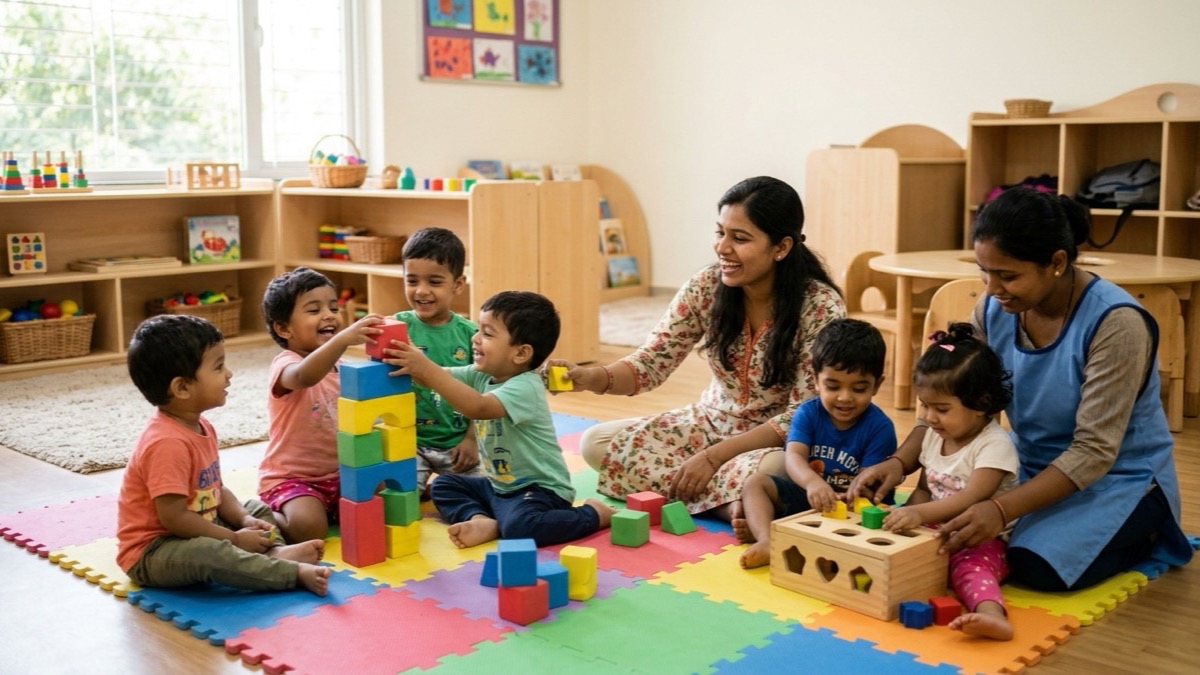
At least two adults for every 20 children. The National Commission for Protection of Child Rights (NCPCR) guidelines for private play schools recommend one teacher and one caregiver for every 20 children. Treat that as a minimum. Many good preschools keep smaller groups, especially for two- and three-year-olds.
For comparison, the US accreditation body NAEYC recommends about one adult for every 9 to 10 children aged three to four. Younger children need more hands: someone to help with toilets, spills and tears while the teacher keeps the group going.
Ask the ratio for your child's actual class, at the busiest time of day, and whether it includes the caregivers or only teachers. A school that answers with a number straight away has usually thought about it.
What qualifications should preschool teachers have?
Look for a recognised early childhood qualification, such as a diploma in early childhood education, Nursery Teacher Training (NTT) or Montessori certification, plus regular in-service training. Then ask how long the lead teacher has been at the school. Steady teachers matter as much as certificates.
Good questions:
- What qualification does my child's class teacher have?
- How are new teachers trained, and how often does training happen?
- How long have the current teachers been here?
High teacher turnover is one of the clearest warning signs. Young children need familiar faces to feel safe enough to learn.
What should a good preschool curriculum look like?
Mostly play. India's National Curriculum Framework for the Foundational Stage (2022) treats learning through play as the core of education from ages 3 to 8. A good preschool day is full of talk, stories, songs, movement, building, art and outdoor time, with early letters and numbers woven in.
The NCPCR guidelines suggest 3 to 4 hours of instruction a day for children aged 3 to 6, following the National ECCE Policy 2013. Longer than that, and it should be care and rest, not more teaching.
Be wary of homework for three-year-olds, rows of children copying letters, or a pitch built around how early children will "start writing". Our post on the importance of playtime for toddlers explains why play does the real work at this age.
What should you ask about fees?
Ask for an itemised fee sheet in writing before you pay anything. It should list every charge for the year, how often each is paid, what happens if you withdraw, and how much fees usually rise. Surprises later are almost always items that were never written down.
A complete fee sheet covers:
| Item | Ask |
|---|---|
| Admission or registration fee | One-time? Refundable? |
| Tuition | Monthly, quarterly or annual? |
| Annual charges | What do they cover? |
| Books, kits and uniforms | Included, or bought separately? |
| Activities and events | Any extra charges during the year? |
| Transport, meals, daycare | Optional? Priced separately? |
| Withdrawal and refunds | What do you get back if you leave mid-year? |
| Annual increase | By how much, typically? |
The NCPCR guidelines say fees should be collected monthly or quarterly, and that play schools should not charge a capitation fee. If a school asks for a large lump sum or a "donation" to secure a seat, ask why.
What should you check on a preschool visit?
Visit during a normal session, not only an open day, and spend at least half an hour. Watch how adults speak to children, how a crying child is comforted, and whether children seem busy and relaxed. Take this checklist with you.
Printable preschool visit checklist
Ask
- What is the adult-to-child ratio in my child's class, including caregivers?
- Are all staff, including helpers, guards and drivers, police-verified?
- Who monitors the CCTV, and how long is footage kept?
- How does pickup work for someone new?
- What qualification does the class teacher have, and how long has she or he been here?
- What does a typical day look like, hour by hour?
- How do you help new children settle in?
- How and how often will you update me about my child's day?
- Can I have the full fee sheet, including refunds, in writing?
Look for
- One secure entrance, with visitors signed in
- Child-height toilets and wash basins near the classroom
- Clean, safe play space, indoors and out
- Children's own artwork on the walls, not identical printed sheets
- Teachers kneeling or sitting at children's level, speaking calmly
- Fire extinguishers, marked exits and a first-aid kit
- Childline 1098 displayed
Walk away if
- They won't let you see a normal classroom
- Answers on staff checks or pickup are vague
- Your child is tested or interviewed for admission
What are the red flags?
Any sign that safety is improvised, that adults are stretched too thin, or that the school is selling early academics instead of childhood. One red flag is worth a follow-up question. Two or three are a reason to keep looking.
- You are not allowed to see classrooms in session.
- Staff checks, CCTV or pickup rules are "being worked on".
- One adult is managing a large group on their own.
- Lots of new teachers, or your child's teacher has changed twice in a year.
- Homework, tests or "writing practice" for two- and three-year-olds.
- Children are shouted at, shamed or made to sit still for long periods.
- An entrance test or interview for your child. The NCPCR guidelines say play schools should not screen children or parents for admission.
- Fees that are not written down, or a large non-refundable lump sum.
How do you help your child settle in?
Expect tears in the first week or two; they are normal. A good preschool has a settling-in plan: short first days, a parent allowed to stay at the start, one familiar adult, and a quick message to tell you how your child is doing. Ask what the first two weeks look like.
At home, talk about preschool simply and positively, keep goodbyes short and cheerful, and always come back when you said you would. Most children settle within a few weeks. If your child is still very distressed after a month, talk to the teacher together.
Are preschools in India regulated?
Only partly, and it varies by state. The NCPCR guidelines for private play schools are national but advisory unless a state adopts them, and in March 2026 Karnataka's school education minister told the Assembly that LKG and UKG were not yet under a regulatory system, with rules promised. That is why your own checks matter so much.
How does Little Ville approach these questions?
We'd rather you visit us with this checklist than without it. With 200+ Little Ville preschools, there may well be one near you. Here is how Little Ville answers some of the questions above:
- No entrance tests. Admission is an enquiry, a call back, a visit and paperwork.
- Ratio in Playgroup: one teacher and two trained caregivers for every six children.
- Safety: child-safe campuses with padded corners, secure entry and supervised play. Every centre follows the same safety protocols: CCTV monitoring, background-verified staff, secure gates and paediatric emergency preparedness.
- Curriculum: the IGNITE™ curriculum, built in-house and aligned to the National Curriculum Framework, covering language, everyday maths, art, movement and sign language.
- Teachers: early-childhood educators trained centrally by Little Ville's academic team, with daily updates to parents.
- Fees in writing: each campus shares its own fee structure, timings and term calendar, including any concessions.
- A real visit: a free 30-minute tour during a normal day, where you can meet the teachers.
Programmes run from Playgroup (2 to 3 years) and Nursery (3 to 4) to Kindergarten (4 to 6). Ask us the safety and ratio questions on your visit, too.
Frequently asked questions
At what age should my child start preschool in India?+
Most children start playgroup between 2 and 3 years. Because the Ministry of Education has asked states to admit children to Class 1 only at 6 or above, count backwards: Nursery around 3 to 4, LKG around 4 to 5 and UKG around 5 to 6. Check your state's cut-off date before applying.
How do I know if a preschool is safe?+
Ask specific questions: are all staff, including helpers and drivers, police-verified; who monitors the CCTV; how does pickup work for someone new; and who supervises toilet visits. The POCSO Rules 2020 require periodic police verification of staff in places that work with children. Vague answers are a warning sign.
What is a good teacher-to-child ratio in a preschool?+
The NCPCR guidelines for private play schools recommend at least one teacher and one caregiver for every 20 children, so two adults per 20. Treat that as a minimum. Many good preschools keep smaller groups, especially for two- and three-year-olds. Ask for the ratio in your child's class at the busiest time of day.
Are preschools in India regulated?+
Only partly. National NCPCR guidelines for play schools exist but are advisory unless a state adopts them, and rules differ from state to state. In March 2026, Karnataka said LKG and UKG were not yet under a regulatory system. Your own checks on safety, staff and fees matter a great deal.
Do preschool teachers in India need qualifications?+
They should have a recognised early childhood qualification, such as a diploma in early childhood education, Nursery Teacher Training (NTT) or Montessori certification, plus regular training. Ask what your child's class teacher holds and how long they have taught at the school. Low teacher turnover matters as much as certificates.
Should a preschool interview or test my child?+
No. The NCPCR guidelines for private play schools say there should be no screening of children or parents for admission. A friendly chat during a visit is normal, but a test, an interview or a ranking of children for a preschool seat is a red flag.
My child cries at drop-off. Is that normal?+
Yes, especially in the first few weeks. Keep goodbyes short and cheerful, and come back when you said you would. A good preschool will have a settling-in plan and will tell you how your child is doing once you leave. If distress continues after a month, talk to the teacher.
Give your child the Little Ville start
Book a campus tour and see our NCF-aligned IGNITE™ curriculum in action across Playgroup, Nursery and Kindergarten.
Book a Campus TourRelated Articles
Edfact Learning Systems Private Limited
406, 8th E Main Rd, HRBR Layout 1st Block, HRBR Layout, Kalyan Nagar, Bengaluru, Karnataka 560043
Admissions: +91 98456 71555 | info@edfact.co.in