
How to Start a Preschool in India (2026): State-Wise Licensing and Setup Checklist
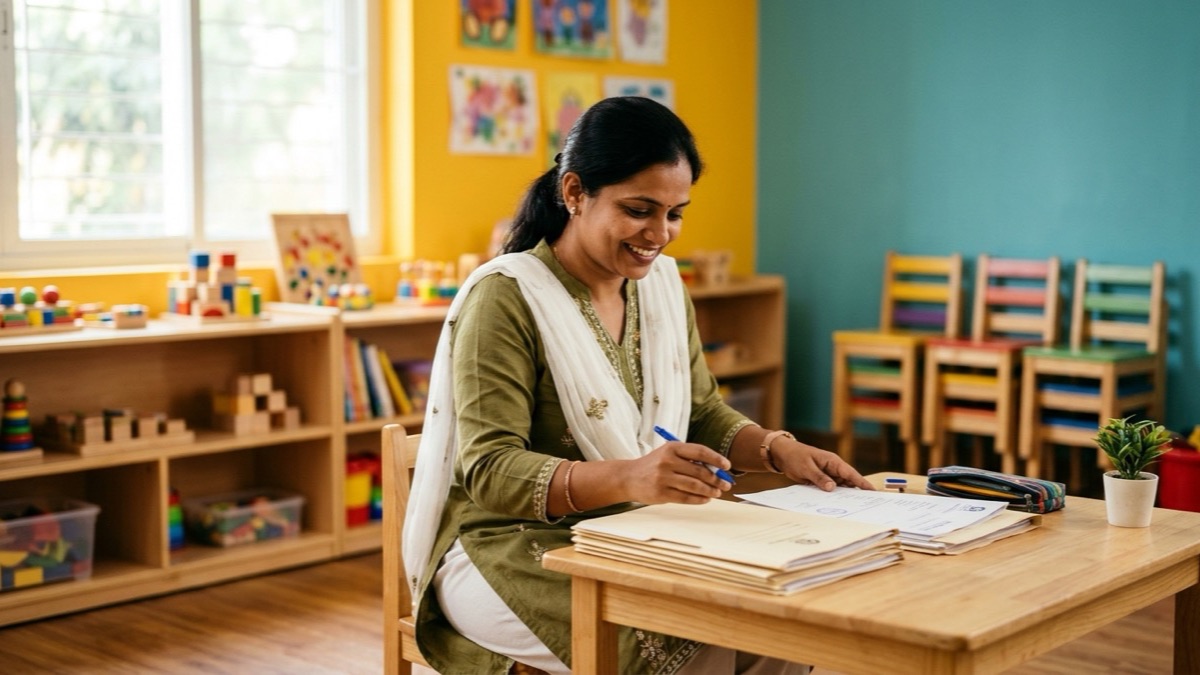
Most "how to start a preschool" guides end with a vague line about getting "all necessary licences". That is the part people actually get stuck on.
Here is the honest position in 2026: there is no single national licence to open a preschool in India. Each state sets its own rules, some by law and some by circular, and several are rewriting them right now. Tamil Nadu has a strict law. Maharashtra made registration compulsory in 2025. Karnataka's rules are still being settled.
This guide gives you the steps in order, a timeline that works back from the June admission season, the documents you will need, what we could confirm for Karnataka, Maharashtra, Tamil Nadu, Delhi and Telangana, and a checklist to print. Everything is dated October 2026. Rules change, so confirm with your local education office before you sign a lease.
Do you need a licence to start a preschool in India?
There is no national preschool licence. Whether you need to register depends on your state: Tamil Nadu requires permission and recognition by law, Maharashtra requires portal registration by circular, and Karnataka and Delhi are still settling their rules. Every preschool must also meet local building and fire safety rules and child-protection law.
Three national layers apply everywhere:
- NCPCR guidelines for private play schools. The National Commission for Protection of Child Rights has published model rules for preschools for ages 3 to 6: ratios, safety, fees and admissions. They are advisory unless your state adopts them. Punjab notified them in 2021.
- NEP 2020 and the Foundational Stage. National policy treats ages 3 to 8 as one "foundational stage", and the National Curriculum Framework for the Foundational Stage (2022) sets out a play-based approach. These shape what you teach, not whether you can open.
- POCSO. The Protection of Children from Sexual Offences Act applies to every preschool, registered or not. Staff must report suspected abuse, and the person in charge of an institution can face up to a year in jail for failing to report an offence by a subordinate.
You do not need CBSE, ICSE or state-board affiliation to run a standalone preschool. Boards affiliate schools, not preschools.
How do you start a preschool, step by step?
Start with demand, not décor. Check that enough young families live within 2 to 3 km, decide between a franchise and your own brand, set a realistic budget, then register, build, hire and market, in roughly that order. Most of the delays come from premises and paperwork, so start those early.
- Study your catchment. Preschools fill from a 2 to 3 km radius. Count apartment blocks and young families, and list every preschool nearby with its fees.
- Choose franchise or independent. Our franchise vs starting your own guide runs both through the same numbers.
- Set your budget. Setup plus at least ₹4–5 lakh of working capital. See our preschool franchise cost breakdown.
- Form your entity. Your state may limit which kinds can run a preschool (see below).
- Secure premises. Ground floor, outdoor play, child-height toilets, and a lease long enough for your state's rules.
- Apply for registrations and safety certificates. Building safety, fire, sanitation, local trade licence where required, and state preschool registration where it applies.
- Fit out the centre. Child-safe interiors, furniture, play equipment, CCTV.
- Hire and verify staff. Qualified teachers, caregivers, housekeeping and security, with background checks for everyone.
- Train and plan. Curriculum, daily routine, safety drills and parent communication.
- Market and open. Open days, local and digital marketing, and enquiries timed to admission season.
When should you start if you want to open in June?
Six to nine months before. Most families choose a preschool between November and March for a June start. To be open and taking visits in that window, you should have premises and an agreement in place by about September or October, with registration and fit-out running through the winter.
| When | What happens |
|---|---|
| August–September | Catchment research, shortlist brands or plan your own, budget |
| September–October | Sign the franchise agreement (if any) and the lease; form your entity |
| October–December | Fit-out; apply for safety certificates and state registration |
| November–March | Admissions season: open days, enquiries, campus visits |
| February–April | Hire and verify staff |
| April–May | Training, safety drills, settling-in plans |
| June | Open |
Starting later? You can still open, but plan for a smaller first intake or a mid-year batch, and budget for a slower first year. Missing the main admission window is one of the most common reasons a first year disappoints; our guide to whether a preschool franchise is profitable shows what that does to returns.
Which business entity should you register?
Most states let you run a preschool as a proprietorship, partnership, LLP or private limited company, but some do not. In Tamil Nadu, only a trust, registered society or Section 8 company can hold play-school permission, and the NCPCR model rules take the same approach. Check your state before you register anything.
| Entity | Usually suits | Watch for |
|---|---|---|
| Sole proprietorship | A single owner-operator, quick start | Not allowed for play-school permission in Tamil Nadu |
| Partnership / LLP | Two or more owners | Not allowed in Tamil Nadu |
| Private limited company | Investors, multiple centres | Not allowed in Tamil Nadu (a Section 8 company is) |
| Trust or registered society | Where state rules require it | Slower to set up; profits stay in the entity |
| Section 8 company | Where state rules require it | Not-for-profit; dividends not allowed |
This is the decision to take advice on. A chartered accountant or lawyer can tell you which structure your state allows and how you will be paid from it.
What licences and documents do you need?
Expect to need proof of your entity, a registered lease or ownership document, a building safety certificate, fire safety clearance, a sanitary or health certificate and, in some states, a preschool registration or recognition. Whether you also need a trade licence or shops and establishments registration depends on your city, so ask.
| Document | What it is | Where it's needed |
|---|---|---|
| Entity registration and PAN | Proof the business exists | Everywhere |
| Lease or ownership document | Registered, for the full premises | Everywhere; Tamil Nadu requires a lease of at least 15 years |
| Structural stability / building safety certificate | From an engineer or the public works department | Tamil Nadu by law; commonly asked for elsewhere |
| Fire safety NOC | From the state fire service | Tamil Nadu by law; thresholds elsewhere vary, so ask |
| Sanitary / health certificate | From the local health authority | Tamil Nadu by law; commonly asked for elsewhere |
| State preschool registration | Varies by state | See the state section below |
| Trade licence | From the city or town authority | Check with your local body |
| Shops and establishments registration | State labour department | Check whether your state's Act covers preschools |
| Staff background checks and affidavits | Police verification, non-conviction affidavits | Best practice everywhere; required under Tamil Nadu's play-school code |
What are the preschool licensing rules in your state?
They differ a lot. Tamil Nadu has the clearest rules, set by law. Maharashtra requires online registration. Karnataka requires registration of educational institutions under its Education Act, but says its preschool rules are still being written. Delhi announced registration in 2024. Telangana has no confirmed requirement. Always confirm locally.
| State | Registration required? | Under what | Who to ask |
|---|---|---|---|
| Tamil Nadu | Yes: permission, then recognition | Tamil Nadu Private Schools (Regulation) Act 2018 and Rules 2023 | District Education Office |
| Maharashtra | Yes: online registration | School Education Department circular, 24 April 2025 | Pre-School Registration Portal, education.maharashtra.gov.in |
| Karnataka | Unsettled | Karnataka Education Act 1983; preschool law promised | Block Education Officer / DDPI |
| Delhi | Announced in 2024, roll-out unconfirmed | Women and Child Development department, NCPCR-based | WCD department and Directorate of Education |
| Telangana | Not confirmed | No standalone preschool rule found | District Education Office; GHMC for local licences |
Karnataka
The Karnataka Education Act 1983 says private educational institutions must be registered, and the education department reads that as covering pre-primary classes. But in March 2026, the School Education Minister told the Assembly that LKG and UKG are not yet regulated under a clear legal framework and promised a new law. Until it arrives, ask your Block Education Officer what applies to your centre.
What is already in place:
- Space: the state's 1995 rules for educational institutions set at least 6 sq ft of carpet area per student, a playground, drinking water and separate toilets. Admission tests are not allowed up to primary level.
- Age: LKG at 4 and UKG at 5 by 1 June, and Class 1 at 6, from 2025-26, with a one-time 60-day relaxation for 2026-27.
- Bengaluru: the Greater Bengaluru Authority replaced BBMP in May 2025, and trade licences now run online under it and its five city corporations. Its 2026 rules refuse trade licences to businesses started after 2015 on residential roads narrower than 40 ft, so check the road before you sign a lease.
- Shops and establishments: an amendment in force from September 2026 makes registration digital and valid until the business closes.
Maharashtra
Since a School Education Department circular of 24 April 2025, every private pre-primary centre for ages 3 to 6 must register on the state's Pre-School Registration Portal. About 13,800 centres had registered by July 2026. The portal records your building, classrooms, toilets, CCTV and staff. A dedicated preschool law has been announced but was not in force as of October 2026.
Age rules are changing too. An order reported in October 2026 moves the cut-off date to 30 June and phases in new ages from 2027-28, reaching Class 1 at 6 in 2030-31.
Tamil Nadu
Play schools are covered by the Tamil Nadu Private Schools (Regulation) Act 2018. You need permission before you open and recognition before admissions, and only a trust, registered society or Section 8 company can apply. Running without permission can mean a fine of up to ₹1 lakh, plus a daily fine while it continues.
Under the 2023 Rules, as published:
- Two applications: permission to establish (fee ₹10,000), then recognition (fee ₹5,000), applied for six months before admissions.
- Documents: structural stability certificate and building licence, sanitary certificate, fire NOC, and a registered lease of at least 15 years.
- Deposits: a ₹50,000 fixed deposit in the school's name for at least seven years, plus one month's staff salary held in reserve.
Tamil Nadu's older 2015 code for play schools also set ground-floor classrooms, at least 10 sq ft per child and no more than 15 children per teacher. Ask the District Education Office whether it still applies alongside the 2023 Rules.
Delhi
In January 2024, Delhi's Women and Child Development department announced that all play schools would have to register, using a form based on the NCPCR guidelines and a district inspection. We could not confirm that the process has been fully rolled out. In 2026, the government acted against an unrecognised play school after an incident, so assume you will need to register, and ask both the WCD department and the Directorate of Education.
Telangana
We found no confirmed registration requirement for standalone preschools in Telangana as of October 2026. In practice, operators in Hyderabad usually obtain a GHMC trade licence and fire and sanitary certificates. Ask the District Education Office before you open, as the state has been reviewing private school rules.
Other states: check with both the school education department and the women and child development department. Either may be responsible.
What does NEP 2020 change for a new preschool?
It makes preschool the first three years of a five-year "foundational stage" from age 3 to 8, and pushes Class 1 to age 6. In practice, a preschool now offers three years (Nursery, LKG, UKG), often with a playgroup before that, and should teach through play, as the national curriculum framework describes.
The Ministry of Education wrote to all states in February 2024 asking them to admit children to Class 1 only at age 6 or above, and wrote again to six states in January 2026. States are moving at different speeds: Karnataka from 2025-26, Delhi from 2026-27, Maharashtra from 2030-31.
Two things this means for your business:
- Children stay longer. A child who joins playgroup can stay three to four years, so retention is worth more than ever.
- Age cut-offs drive admissions. Parents now ask which class their child belongs in. Know your state's dates.
What staff do you need, and what checks?
A centre head, qualified teachers, caregivers or helpers, housekeeping and security. NCPCR's model guidelines suggest at least one teacher and one caregiver for every 20 children. Run a background check on every staff member, including drivers and helpers, and keep signed non-conviction affidavits on file.
For teachers, look for a recognised early childhood qualification such as a diploma in early childhood education, Nursery Teacher Training (NTT) or Montessori certification. Few states prescribe a preschool qualification yet; Maharashtra's draft law would.
On safety, police verification and CCTV are required in Tamil Nadu's play-school code and recommended in NCPCR's 2021 school safety manual. Treat both as standard practice everywhere. Parents increasingly ask about them on the first visit.
What premises work for a preschool?
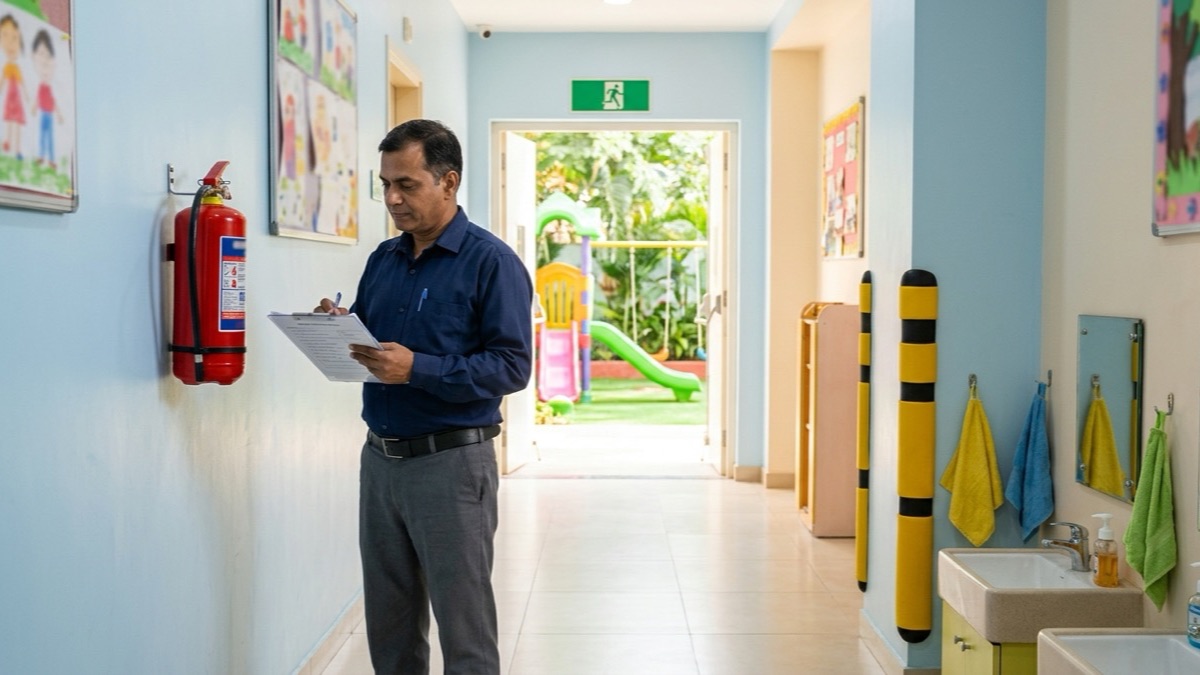
A ground-floor space with its own entrance, outdoor play area, child-height toilets and room to grow. NCPCR's safety manual advises keeping nursery classes on the ground floor, and Tamil Nadu requires it. Check the area your state and brand require, and the lease length your state demands, before you sign.
What to check before signing:
- Floor: ground floor, with step-free access and two exits.
- Area: state rules where they exist (Karnataka: 6 sq ft of carpet area per student; Tamil Nadu's 2015 code: 10 sq ft per child), and your brand's minimum. Large brands ask for 1,500 to 3,500 sq ft.
- Lease length: at least 15 years in Tamil Nadu; long enough everywhere to recover your fit-out.
- Zoning and road: whether a preschool or trade licence is allowed at that address. In Bengaluru, check the road width.
- Toilets and water: child-height toilets and basins near classrooms, safe drinking water.
Do you need GST registration for a preschool?
Preschool fees are exempt from GST: the 2017 exemption notification expressly covers pre-school education. But franchise fees and royalties paid to a franchisor generally attract 18% GST, and because your own fees are exempt, you usually cannot claim that tax back. Budget it as a real cost and ask a CA.
Two points to raise with your accountant: whether you need GST registration at all for any taxable extras you sell, and whether an unregistered preschool still counts as an "educational institution" for the exemption.
Your preschool setup checklist
Print this and tick it off. Items marked "check" depend on your state or city.
Plan
- Catchment checked: young families and competing preschools within 2 to 3 km
- Franchise or independent decided
- Budget: setup plus ₹4–5 lakh working capital
Register
- Entity formed (check what your state allows)
- PAN and bank account
- State preschool registration or recognition (check)
- Trade licence and shops and establishments registration (check)
Build
- Ground-floor premises, registered lease of the right length
- Structural safety and sanitary certificates
- Fire safety NOC (check threshold) and extinguishers, exits, drills
- Child-safe fit-out, CCTV, secure single entrance
Staff
- Centre head and qualified teachers hired
- Background checks and affidavits for every staff member
- Child protection policy and POCSO reporting process
Launch
- Curriculum and daily routine ready
- Fee sheet written and itemised
- Open days and admissions marketing timed to November–March
How Little Ville helps you start
If you open as a Little Ville franchise partner, you join a network of 200+ preschools, and much of the list above comes with support. Little Ville's franchise team lists:
- Property selection audit, plus ground-floor layouts, paint schemes and safety templates
- Help with registrations and approvals in your state
- Recruiting and training teachers, with continuous training camps
- The [IGNITE™ curriculum](/ignite) (NCF-aligned, built in-house) with proprietary kits and materials
- Admissions: HQ-run digital admission marketing, plus an admission app and CRM dashboard
Little Ville runs a zero-royalty model, with an investment of ₹10–15 lakh in metros (Bangalore, Chennai, Hyderabad) and ₹8–10 lakh in other towns, for a ground-floor centre of 2,000–3,500 sq ft carpet area.
Frequently asked questions
Do I need a licence to start a preschool in India?+
There is no national preschool licence. It depends on your state. Tamil Nadu requires permission and recognition by law, and Maharashtra requires online registration. Karnataka and Delhi are still settling their rules. Every preschool must also meet local building, fire and child-protection rules, so check with your district education office.
What documents are required to start a preschool?+
Usually: entity registration and PAN, a registered lease or ownership document, a structural safety certificate, a fire safety NOC, a sanitary or health certificate, and your state's preschool registration where it applies. Some cities also need a trade licence. Keep background checks and affidavits for all staff on file.
Do I need CBSE affiliation to open a preschool?+
No. CBSE, ICSE and state boards affiliate schools, not standalone preschools. You may need state registration or recognition depending on where you open, but not board affiliation.
Is GST applicable on preschool fees?+
No. Fees for pre-school education are exempt from GST under the 2017 exemption notification. Franchise fees and royalties paid to a franchisor generally attract 18% GST, and you usually cannot claim it back because your fees are exempt. Ask a chartered accountant about your own position.
Can I start a preschool in a residential building?+
Often, but check before signing. Ground-floor residential houses are common premises, but your local body decides whether a preschool or trade licence is allowed at that address. In Bengaluru, for example, trade licences are refused for businesses started after 2015 on residential roads narrower than 40 ft.
How long does it take to start a preschool?+
Plan for six to nine months before a June opening. Large franchise brands publish timelines of about 45 to 60 days from agreement to opening, but registrations, safety certificates and fit-out often take longer. Aim to be ready to take visits during the November to March admission season.
How do I get a preschool franchise in India?+
Shortlist brands, compare their full fee lists and published figures, visit existing centres, then apply. The brand will usually assess your location and budget before signing an agreement. Ask for every one-time and recurring fee in writing, and check what help they give with registrations.
Ready to own a Little Ville preschool?
Zero royalty, full setup support, and the proven IGNITE™ curriculum. Explore how our 200+ franchise partners built profitable preschools.
Explore the FranchiseRelated Articles
Edfact Learning Systems Private Limited
406, 8th E Main Rd, HRBR Layout 1st Block, HRBR Layout, Kalyan Nagar, Bengaluru, Karnataka 560043
Admissions: +91 98456 71555 | info@edfact.co.in