
Is a Preschool Franchise Profitable? An Honest 2026 Profit and Payback Breakdown
Short answer: yes, a preschool franchise is usually profitable. But not quickly, and not everywhere.
A well-run centre in a good catchment earns a healthy margin once it fills up. The catch is the start. A new centre usually loses money for several months, and getting your full investment back takes closer to three years than the "12 to 18 months" often quoted.
This post shows the working: one illustrative centre, run through best, expected and worst cases over five years, with every assumption listed so you can swap in your own numbers.
Still pricing the setup? Start with our preschool franchise cost breakdown. This post covers what you earn back.
Is a preschool franchise profitable in India?
Yes, usually. In our expected case, an ₹18 lakh Tier-2 centre makes its first monthly profit around month 9 to 12 and recovers its full investment in three to four years. That holds if you reach 85 to 100 children by year three, keep rent modest, and open in time for admission season.
When one of those slips, the picture changes fast. In our worst case, with 20 children in year one and 70 by year five, the centre does not recover its investment within five years at all. So the honest answer is: yes, if the location and enrolment work. Here is the math.
The model behind every number in this post
This is an illustrative model, not a forecast for any centre or brand. Your city, rent, fees and staffing will differ. Use it to test the numbers any franchisor shows you.
| Assumption | Value used |
|---|---|
| Centre | Tier-2 city, about 2,500 sq ft, leased ground floor |
| One-time setup (incl. franchise fee and rent deposit) | ₹18 lakh |
| Working-capital reserve on top | ₹4–5 lakh |
| Average realised income per child | ₹4,500 a month (tuition plus admission, kit and activity income, averaged) |
| Rent | ₹50,000 a month, rising 5% a year |
| Staff (centre head, teachers, caregivers, housekeeping, security) | ₹95,000 a month in year 1, rising to ₹1.7 lakh by year 5 |
| Other running costs (utilities, consumables, marketing, software, upkeep) | ₹40,000 a month in year 1, rising to ₹55,000 by year 5 |
| Royalty | Compared at 0% and at 12% of revenue |
| Not included | Owner's own salary, income tax, loan interest |
Average enrolment in each scenario:
| Scenario | Year 1 | Year 2 | Year 3 | Year 4 | Year 5 |
|---|---|---|---|---|---|
| Best | 45 | 80 | 100 | 105 | 105 |
| Expected | 35 | 65 | 85 | 95 | 100 |
| Worst | 20 | 40 | 55 | 65 | 70 |
How does a preschool actually make money?
A preschool earns almost all its income from parents: monthly or term tuition, plus admission fees, annual kit, uniform and book charges, and activity or event fees. Some centres add daycare or after-school hours. Averaged across the year, our model assumes ₹4,500 of realised income per child per month.
"Realised" matters: sibling concessions, early-bird discounts and mid-term leavers all pull the brochure fee down.
Ranking pages commonly quote tuition of ₹2,000–4,000 per child per month (observed October 2026). Our ₹4,500 is higher because it spreads admission and kit income across the year. Where fees are lower, you will need more children to break even.
Costs, on the other hand, are mostly fixed. Rent, salaries and utilities barely change between 30 children and 90, so once you pass break-even, each extra child is mostly profit. At maturity, 100 children bring in about ₹4.5 lakh a month. The rest of this post is about how quickly you get there.
What does a worked preschool P&L look like?
Here is the expected case over five years. Revenue grows from ₹18.6 lakh in year one to ₹53.7 lakh in year five as enrolment rises from 35 to 100 children. Costs grow too, but more slowly, so the centre moves from a year-one loss to a solid operating profit by year three.
| Year 1 | Year 2 | Year 3 | Year 4 | Year 5 | 5-yr total | |
|---|---|---|---|---|---|---|
| Revenue | 18.6 | 34.4 | 45.2 | 51.0 | 53.7 | 202.9 |
| Rent | 6.0 | 6.3 | 6.6 | 6.9 | 7.3 | 33.1 |
| Staff | 11.4 | 15.6 | 18.0 | 19.2 | 20.4 | 84.6 |
| Other running costs | 4.8 | 5.4 | 6.0 | 6.2 | 6.6 | 29.0 |
| Royalty at 12% (royalty model only) | 2.2 | 4.1 | 5.4 | 6.1 | 6.4 | 24.3 |
| Operating profit, zero royalty | −3.6 | 7.1 | 14.6 | 18.6 | 19.4 | 56.1 |
| Operating profit, 12% royalty | −5.8 | 3.0 | 9.2 | 12.5 | 12.9 | 31.8 |
What stands out:
- Year one loses money either way. That is normal; keep cash aside for it.
- Staff, not rent, is the biggest cost. Over five years it is ₹84.6 lakh, around 42% of revenue. Good teachers are the product, so do not cut here.
- Royalty adds up. At 12%, it totals ₹24.3 lakh over five years. That is more than the ₹18 lakh you spent to open the centre.
- "Operating profit" is before you pay yourself, before income tax and before loan interest.
How long is the payback period?
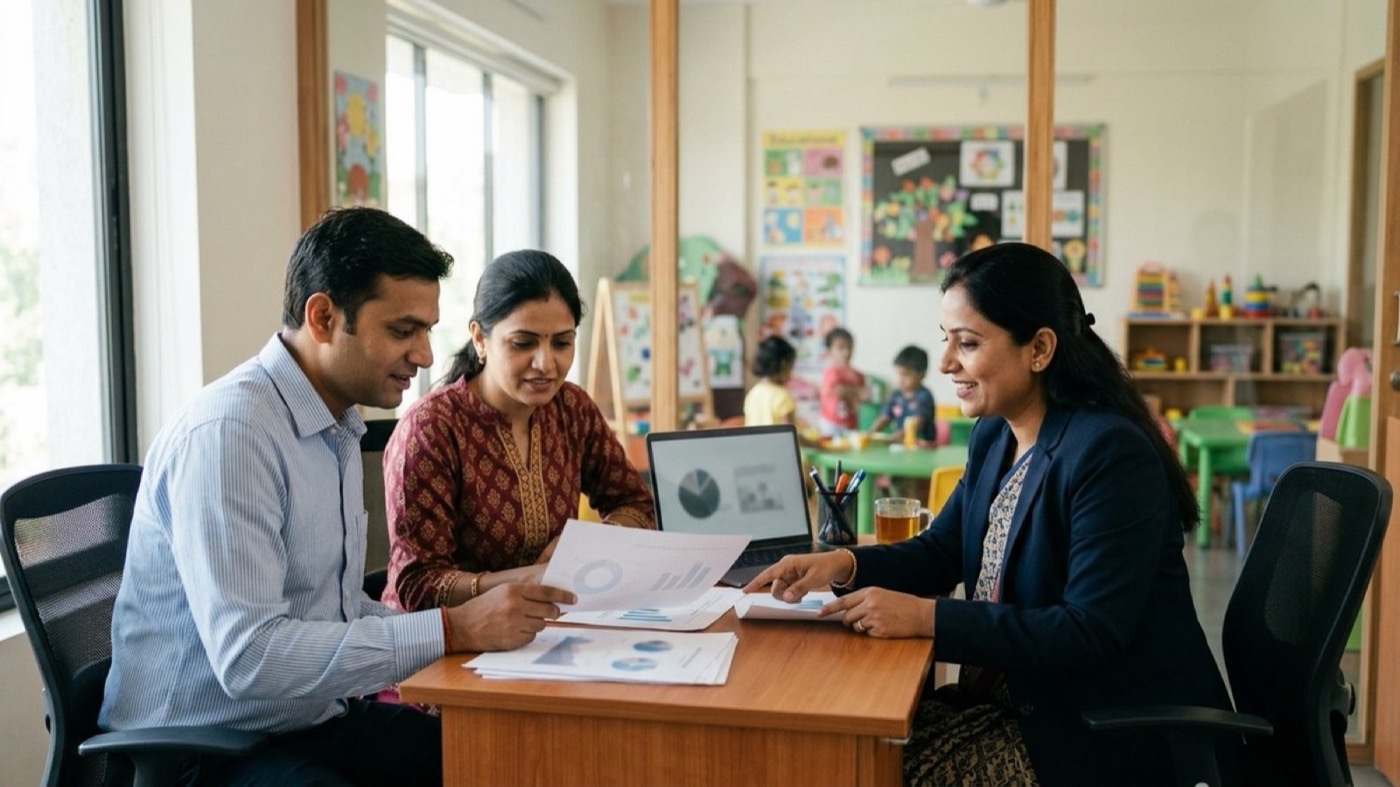
In our expected case, payback, meaning getting your ₹18 lakh setup back, takes about 36 months with zero royalty and about 48 months with a 12% royalty. Break-even, the first month the centre makes a profit, comes much sooner: around month 9 or month 12.
Break-even vs payback: the difference that matters
These two terms get used interchangeably. They are not the same.
- Break-even is the first month your fee income covers that month's running costs. You have stopped losing money, but not made any back.
- Payback is the month your total profits have repaid everything you put in: the setup and the losses from the early months.
In the expected zero-royalty case, there are 27 months between the two. When a brand says "break-even in 12 to 18 months", it usually means the first. As an investor, plan around the second.
| Scenario | Royalty | First profitable month | Setup recovered (payback) | Net position after 5 years |
|---|---|---|---|---|
| Best | 0% | Month 6 | Month 25 | +₹67 lakh |
| Best | 12% | Month 8 | Month 32 | +₹40 lakh |
| Expected | 0% | Month 9 | Month 36 | +₹38 lakh |
| Expected | 12% | Month 12 | Month 48 | +₹14 lakh |
| Worst | 0% | Month 33 | Not within 5 years | −₹31 lakh |
| Worst | 12% | Not within 5 years | Not within 5 years | −₹47 lakh |
Net position = total operating profit over five years minus the ₹18 lakh setup. Before owner salary, tax and loan interest.
The cash-flow valley of months 1 to 12
Before any profit comes a valley. You have spent ₹18 lakh, and for several months fee income does not cover year-one running costs of about ₹1.85 lakh a month.
In the expected case, your deepest point is about ₹22 lakh out of pocket in total. So keep ₹4–5 lakh of working capital on top of the setup budget. Running out of cash just before the centre turns the corner is one of the most avoidable ways to fail.
Footprints, which runs a managed investor model at a much higher ticket size, also notes on its franchise page that the first 12 months or so yield no returns (published, October 2026).
How many children do you need to break even?
In our model, about 41 children a month in year one with zero royalty, or about 47 with a 12% royalty. The number rises over time as rent and salaries go up: about 57 vs 64 in year three, and about 64 vs 72 in year five.
| Year | Zero royalty | 12% royalty | Extra children needed for royalty |
|---|---|---|---|
| Year 1 | ~41 | ~47 | 6 |
| Year 3 | ~57 | ~64 | 7 |
| Year 5 | ~64 | ~72 | 8 |
Two practical points. First, check your building's real capacity. If it can only hold about 60 children comfortably, a 12% royalty model would leave you below break-even by year five, however well you run it.
Second, our numbers sit close to published examples. Podar's published case study (podarworld.org, reported October 2026) describes a ₹25 lakh centre breaking even in year one at about 50 students and ₹1.8 lakh a month in revenue. Our year-one break-even is about ₹1.85 lakh a month. Different assumptions, a similar answer.
What can go wrong? The worst-case scenario
In our worst case, enrolment is 20 children in year one and only 70 by year five. With zero royalty, the first profitable month is month 33 and you finish five years ₹31 lakh down. With a 12% royalty, the centre never makes a monthly profit in five years and you are ₹47 lakh down.
Nothing exotic causes this: same centre, same rent, same staff, fewer children. Here is what usually drives returns down.
1. Under-enrolment
With 20 children against a break-even of about 41, fee income covers roughly half of your monthly costs. The usual causes: a weak catchment, too many preschools nearby, poor visibility, or a first-floor space parents dislike. Spend more time on site selection than on interiors.
2. Missing the admission season
Most families choose a preschool months before the academic year starts in June. Open in August or September and the main intake has gone; year one runs on late joiners. That alone can push a first year from the expected case towards the worst. Plan your launch backwards from admission season.
3. Rent that is too high
Every extra ₹10,000 a month in rent needs about two more children just to stand still. A "premium" location at ₹1 lakh a month, double our model, needs about 11 more children every month before you make a rupee. A good location is worth paying for only if it brings those extra families.
4. Royalty
A 12% royalty adds 6 to 8 children to your monthly break-even and costs ₹24.3 lakh over five years in the expected case. It also grows as you succeed, because it is charged on revenue, not profit.
Two quieter risks: heavy discounting to fill seats, which raises break-even, and teacher turnover, which hurts parent trust and re-enrolment.
What profit margin is realistic?
For a mature, well-filled preschool, an operating margin of about 32–36% is realistic with zero royalty, or about 20–24% with a 12% royalty, before owner salary and tax. Year one is negative. Margins of 50–60% that you may see online usually leave out some of the real costs.
| Year 1 | Year 3 | Year 5 | |
|---|---|---|---|
| Zero royalty | −19% | 32% | 36% |
| 12% royalty | −31% | 20% | 24% |
Published figures across ranking pages vary widely: net margins of 15–30% are common, and some pages claim 35–60% (observed October 2026). Podar's published case study reports about 30% net margin in year two at around 90 students, which is close to our year-three figure.
A simple test for any margin claim: in our model, staff alone is about 38% of revenue in year five, and rent another 14% or so. A 60% margin would leave just 2% of revenue for rent and everything else after staff. That is not a planning number.
Also watch margin vs ROI. Little Millennium, for example, states an ROI of about 30–35% a year on its franchise page, with a disclaimer that results vary (published, October 2026). ROI is profit against your investment; margin is profit against revenue. Neither means much until you know what is included. Compare brands' published figures in our top preschool franchises in India roundup.
How does royalty change your profit?
More than most investors expect. At 12% of revenue, royalty costs ₹24.3 lakh over five years in our expected case. It cuts the five-year net position from ₹38 lakh to ₹14 lakh and pushes payback from month 36 to month 48.
The five-year bill is ₹27.9 lakh in the best case and still ₹16.0 lakh in the worst, because royalty is charged on revenue, profit or not.
Royalty is not automatically bad; some brands give real value for it. The question is whether that support earns back more than it costs. More in our explainer on the zero-royalty preschool franchise model.
How Little Ville's model affects your returns
Little Ville charges zero royalty, so the zero-royalty rows in every table above apply. In the expected case, that means payback around month 36 instead of 48, and about ₹24 lakh more in your pocket over five years.
A few other details line up with the model:
- Investment of ₹15–25 lakh. Our ₹18 lakh illustrative centre sits inside this range. Ask for the line-item cost sheet for your city.
- Space of 2,000–3,500 sq ft carpet area, ground floor, outdoor play area preferred. That gives room for the 85 to 100 children the expected case relies on.
- HQ-run digital admission marketing, plus an admission app and CRM dashboard. These target the two biggest risks above: under-enrolment and a slow first admission season. You can see what parents see on Little Ville's admissions page.
- Teacher training and certification, centre design support and proprietary learning kits, built around the IGNITE™ curriculum, which is NCF-aligned and developed in-house.
- Average break-even of 18–24 months. As with any brand, ask the team whether a figure like this is the first profitable month or full payback, and what enrolment it assumes.
Little Ville has been running preschools since 2008 and is headquartered in Bengaluru. For more on fees, agreements and support, see the Little Ville franchise page.
FAQ
Is a preschool franchise profitable in India?+
Usually, yes, once it fills up. In our illustrative expected case, an ₹18 lakh Tier-2 centre makes its first monthly profit around month 9 (zero royalty) or month 12 (12% royalty) and earns about ₹13–19 lakh a year in operating profit by year five. Weak enrolment can wipe that out, so location and admissions matter most.
What is the profit margin of a preschool franchise?+
A mature, well-filled preschool can realistically make an operating margin of about 32–36% with no royalty, or about 20–24% with a 12% royalty, before owner salary and income tax. The first year is usually loss-making. Margins of 50–60% quoted online rarely account for full staff, rent and royalty costs.
How long does it take a preschool franchise to break even?+
In our expected case, the first profitable month arrives around month 9 to 12. Recovering your full setup investment (payback) takes longer: about 36 months with zero royalty and 48 months with a 12% royalty. Always ask a franchisor which of these two they mean by "break-even".
How many students does a preschool need to break even?+
In our model, about 41 children a month in year one with zero royalty, or about 47 with a 12% royalty, at an average realised income of ₹4,500 per child. The number rises as rent and salaries grow, to roughly 64 (zero royalty) or 72 (12% royalty) by year five.
How much can you earn from a preschool franchise per month?+
Once a centre is full, roughly ₹1–1.6 lakh a month in operating profit is realistic in our expected case: about ₹1.6 lakh with zero royalty and about ₹1.1 lakh with a 12% royalty in year five, before owner salary and tax. In year one, expect to earn nothing and to fund some losses.
What is the ROI of a preschool franchise in India?+
Published claims are often around 25–35% a year, and some brands quote more. In our expected case, an ₹18 lakh centre returns its investment and leaves about ₹38 lakh on top after five years with zero royalty, or about ₹14 lakh with a 12% royalty, before owner pay and tax. Ask any brand to show the working behind its ROI figure.
Ready to own a Little Ville preschool?
Zero royalty, full setup support, and the proven IGNITE™ curriculum. Explore how our 200+ franchise partners built profitable preschools.
Explore the FranchiseRelated Articles


Edfact Learning Systems Private Limited
406, 8th E Main Rd, HRBR Layout 1st Block, HRBR Layout, Kalyan Nagar, Bengaluru, Karnataka 560043
Admissions: +91 98456 71555 | info@edfact.co.in